ATEQ
technology:
leak testing using tracer gases ATEQ Premier T
Air leak testing whether pressure decay, vacuum decay or mass flow is a non expensive leak test technology, because it uses filtered and compressed free air, but it has its limits. The only option for industrial applications too difficult for air test (leak too small, component too large, flexible, temperature or humidity problems), was to use a helium mass spectrometer . This technology is fragile, expensive to purchase, and expensive to use (cost of helium). There are now other available technologies than the helium mass spectrometer to reduce the cost of trace gas leak testing.
Some applications for extremely small leaks will still require a hard vacuum helium mass spectrometer to test by accumulation in a chamber. For most industrial quality control though, you can get a less expensive alternative like the two solutions that ATEQ proposes , the propylene test and the hydrogen test.
Every solution has a reason to exist.They all work with the principle of trace gas detection, like a helium mass spectrometer. A gas which is uncommon in the atmosphere (propylene, hydrogen or helium) is injected in the part to be tested, after emptying the component from the air it contains. Then a gas detector is placed outside the component and if it senses the presence of this uncommon gas, there is a leak. The gas detector can be hand held (sniffer), attached to a chamber enclosing the component and detecting continuously, or attached to a chamber, waits for a sufficient accumulation of gas in the chamber and then starts the detection.
As both hydrogen and propylene are combustible gases with air, they are used mixed at 5% with 95% with nitrogen which makes their use safe. These mixtures offer the advantage to be less expensive than helium.
The fixturing requirements are also a lot less stringent since those gases are not as viscous or have a larger molecular size which does not soak or stick to the test fixture. This turns into a simpler, less expensive machine.
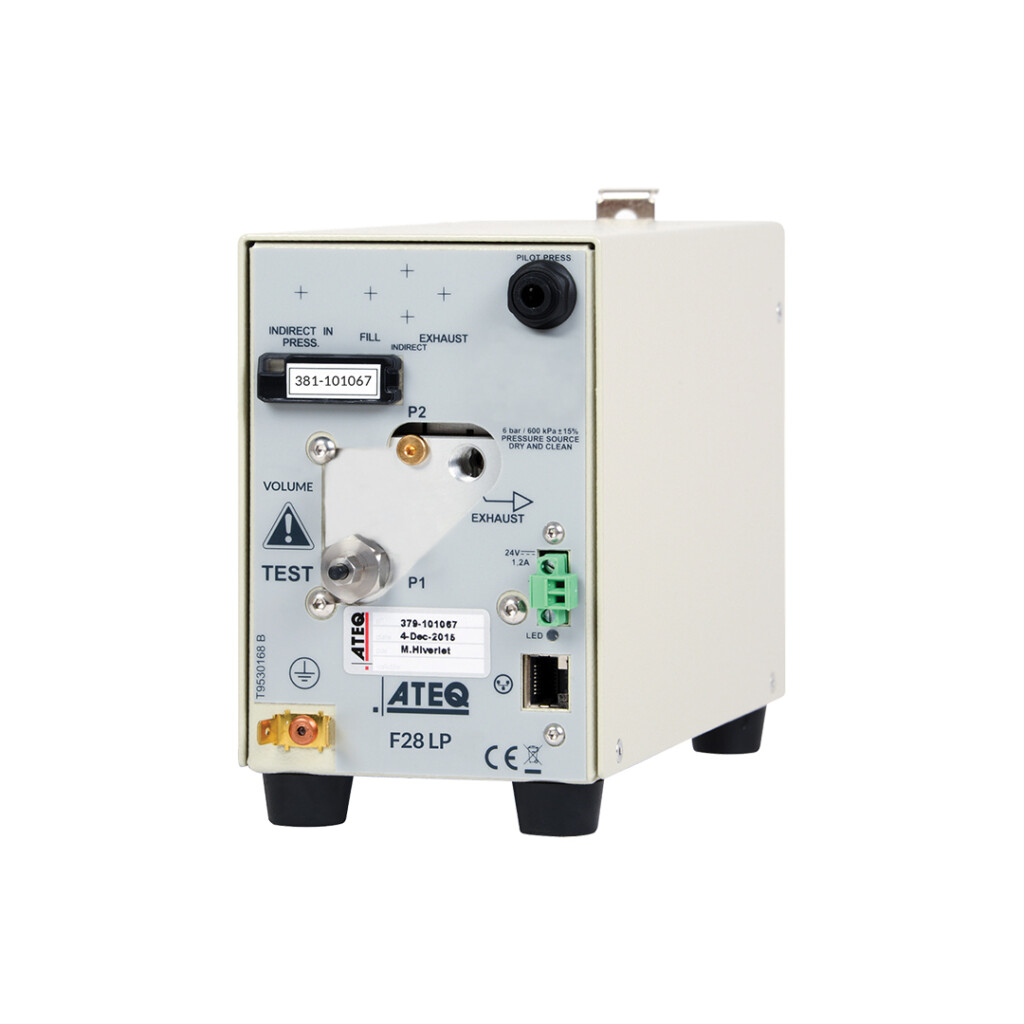
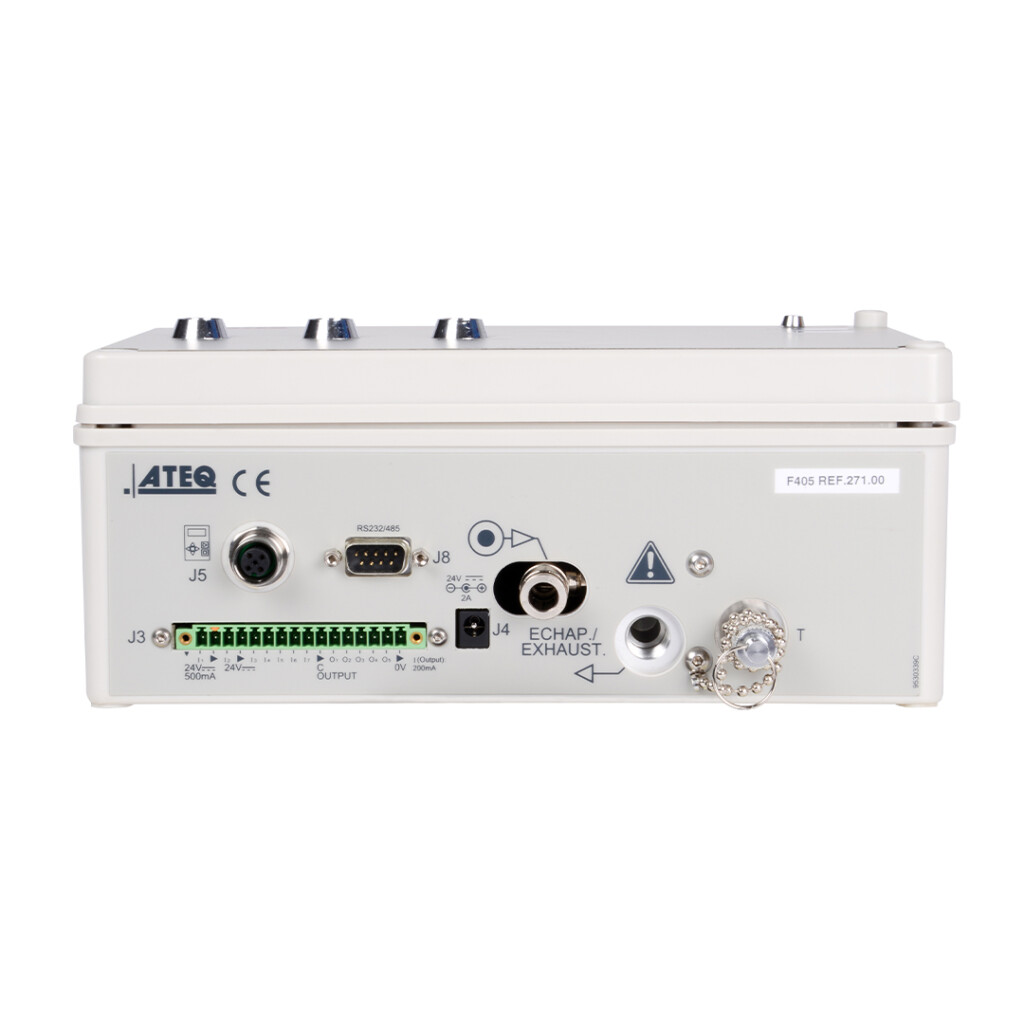
ATEQ propylene detectors are the least expensive of the two: about US$10,000 for an instrument that has built in a complete test cycle with three test modes (sniffing, continuous, accumulation) and
pass fail levels with dry contacts and RS232 output for control with automation.
ATEQ manages to reduce the costs by using the base of its widely used pressure decay and mass flow testers on this instrument. So if propylene can work for your application, but air test can not, propylene test is the way to go.
ATEQ hydrogen tests use a more expensive sensor, separated from the main valve rack that provides the three test modes (sniffing, continuous, accumulation). Hydrogen is used when the propylene is not adequate for the application, like when the molecular size of propylene becomes significant compared to the hole size that you are trying to detect. Hydrogen(H2) and helium (He) are the smallest molecules we know in the universe, so they become a logical choice for detecting the tiniest leaks.
If the ATEQ propylene leak detector tester cannot detect your leaks, and the hydrogen leak detector can, hydrogen is the logical choice since this gas is less expensive than helium.
If the ATEQ engineer says that your leak cannot be detected by the ATEQ air testers, nor by the ATEQ propylene or hydrogen leak detectors, then your last choice will be a helium mass spectrometer.
If you want to know which tracer gas would be right for your application Propylene, Hydrogen or Hellium,
click here to get a list of ATEQ engineers and contact the one closest to you