| |
Mass flow leak testing/Mass extraction leak testing:
There are many different methods to measure air mass flow.
Most use a hot element, like a hot wire, a hot pearl or a
hot silicon chip, to measure the air flow.
When the air flows around a hot element, it cools it down
and the cooling down creates a change in electrical properties
that is measured by electronics.
The heat exchanged based air mass flow is inherently slow
since it involves cooling down something with an air flow.
Of course, the smaller the heating element is the faster it
gets,
and the larger the flow, the faster. The second disadvantage
of heat exchange based mass flow measurement is that cooling
down gives no direction to the flow.
The modern heat based mass flowmeters are smaller to be faster
and use two hot elements to try to find a direction to the
flow.
A hot element also means a necessary warm up time before taking
any measurement.
In order to compensate for the slow response time of a heat
based mass flow element, some manufacturers advertise the
time it takes for the measurement to start to change,
instead of the time it takes to get a fully stabilised signal.
If the measurement has to be that fast, then the measurement
would be done on a non stabilized signal.
Anyone can calibrate an instrument on a non stabilized signal
but there is a trade off: non linearity of the measurement,
unless the element is relinearized on multiple calibration
points, and
significant drift of the measurement with time.
Mass flow means that was is measured by the instrument is
the quantity of molecules (mass) of the air that flows . It
can also be measured by non heat exchange based elements.
ATEQ offers both heat exchange based mass flow meters and
more sophisticated mass flow measurement. The heat exchange
based are mostly used on slow applications with large flows,
or when the budget is limited. On all other applications,
ATEQ can propose inherently fast, inherently directionnal,
linear, non drifting mass flow measurement, without warm up
time.
When mass flow is expressed in vacuum, it is sometime called
mass extraction. ATEQ can provide both mass flow in pressure
and vacuum. The sensitivity of heat exchange based mass flow
diminishes in vacuum, and increases with pressure, so the
recommended vacuum mass flow technology is not heat exchange
based. Working in high vacuum has advantages,
such as being less sensitive to heat exchange and increased
sensitivity of the non heat exchange mass flow sensing element.
There is no mass flow technology that is the best for every
test scenario. There is just a technology that matches better
than another your application and your budget.
Beware of companies who promote one technology as the latest
discovery universal leak test solution, and claim they have
patented the wheel. That's just a clever marketing ploy.
The ATEQ applications engineer is there to listen to your
needs, and recommend the better matching solution accordingly.
Not a one shoe size fits everyone approach.
Mass flow can be experessed in weight units by time like grams
per hour, ounces per year, or in form of a volume of air in
standard conditions of temperature and pressure per unit of
time,
.like standard cubic centimeters per minute (meaning at 1013
mbar of atmospheric pressure and 20 celsius of temperature
in most industries).
Most automotive and other industry air leak test specifications
are written in volumetric flow in strandard conditions, at
a given test pressure.
A test specification like this is independent on the volume
of the component tested plus test fixture, unlike a pressure
drop specification, so it is a better way to write an air
leak test specification..
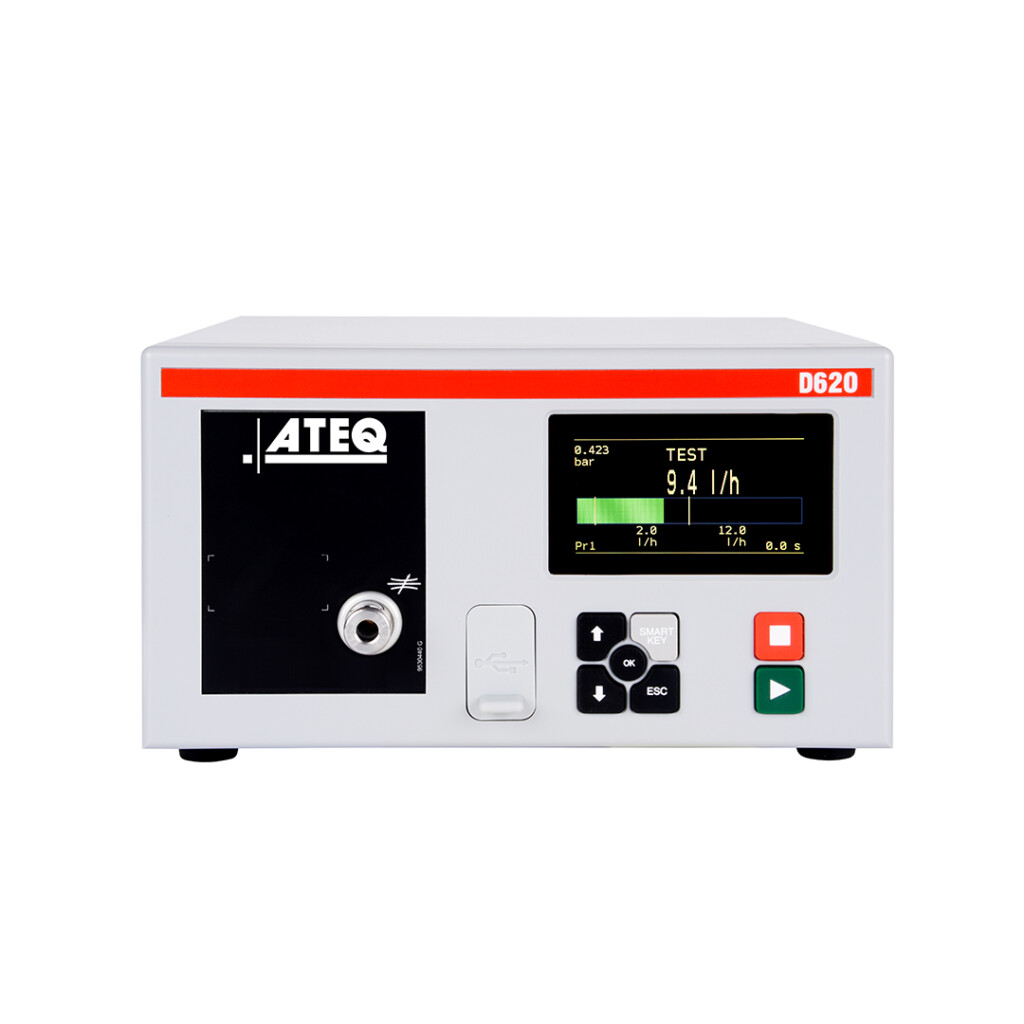
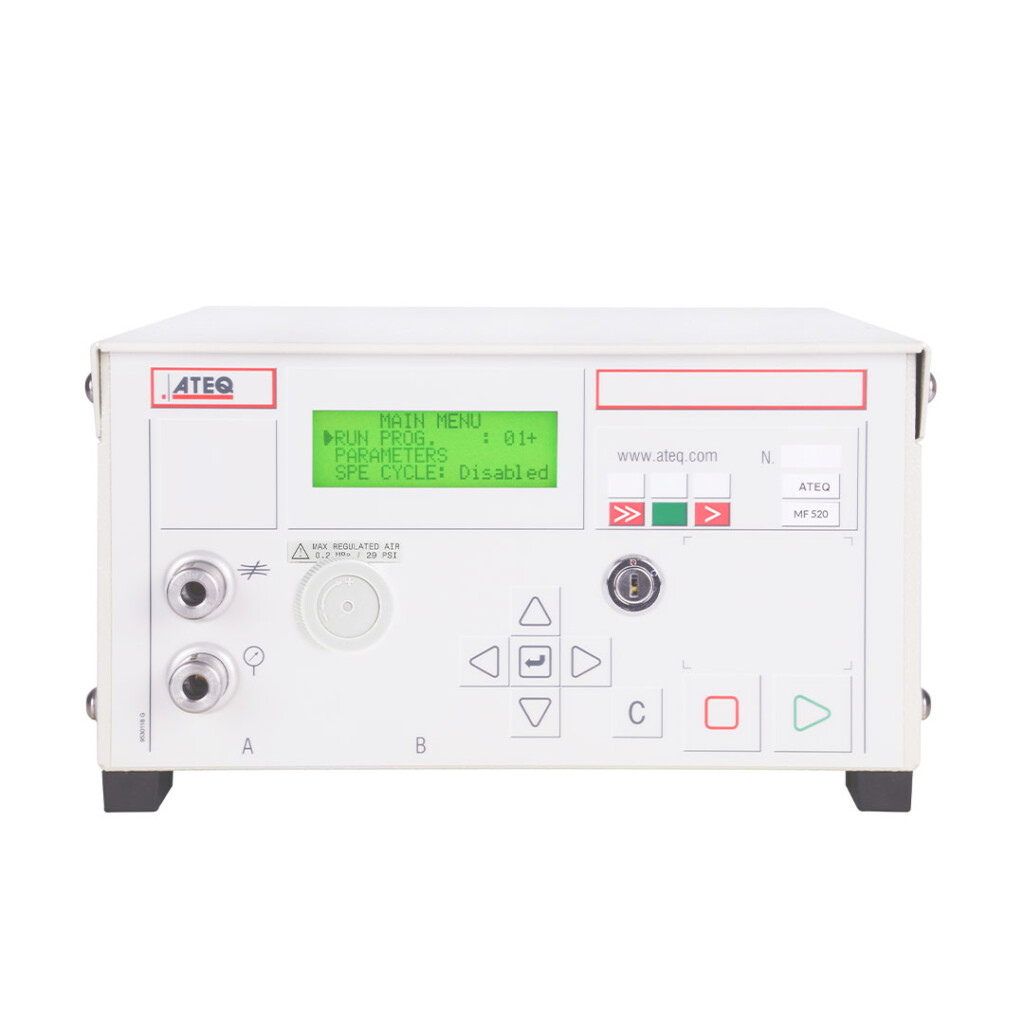
ATEQ uses 3 configurations for mass flow leak testing .
They all have advantages and disadvantages depending on applications.
|
|
| |
advantages:as the air flow comes from a reference part or
reference tank, the supply pressure has less fluctuations
,
so it is a good system for a leak test. Also the reference
part stabilises like the part under test which makes the test
faster,
like a differential pressure decay test is faster than regular
pressure decay. Environmental influences are reduced since both the reference and the test are affecyed in the same way.
Disadvantages: The test is volume dependent. Needs a sometime bulky reference part or reference volume.
|
|