
LEAK/FLOW/TPMS
Leak/flow applications
US local offices
Customer references
News and events
Legal notice
Leak/flow testers
TPMS activator/testers
Fast ID or OD seals
Leak/flow calibrator
Leak/flow standards
Castings blockage test
Air volume/liquid level
pressure switch test
check valve/burst test
Battery electrical test
Low pressure transmit.
Aircraft continuity test
pitot static testers
Hi-pot testers
Ground continuity test
See our product range
Assistance 24h/day
download manuals
RA#/service order
parts and accessories
leak test technologies
Diff. pressure decay
Mass flow test
Laminar flow test
propylene/hydrogen test
Ionized air leak test
Vacuum decay test
Gauge pressure decay
Carrers/Employment
Representations needed
Sales positions


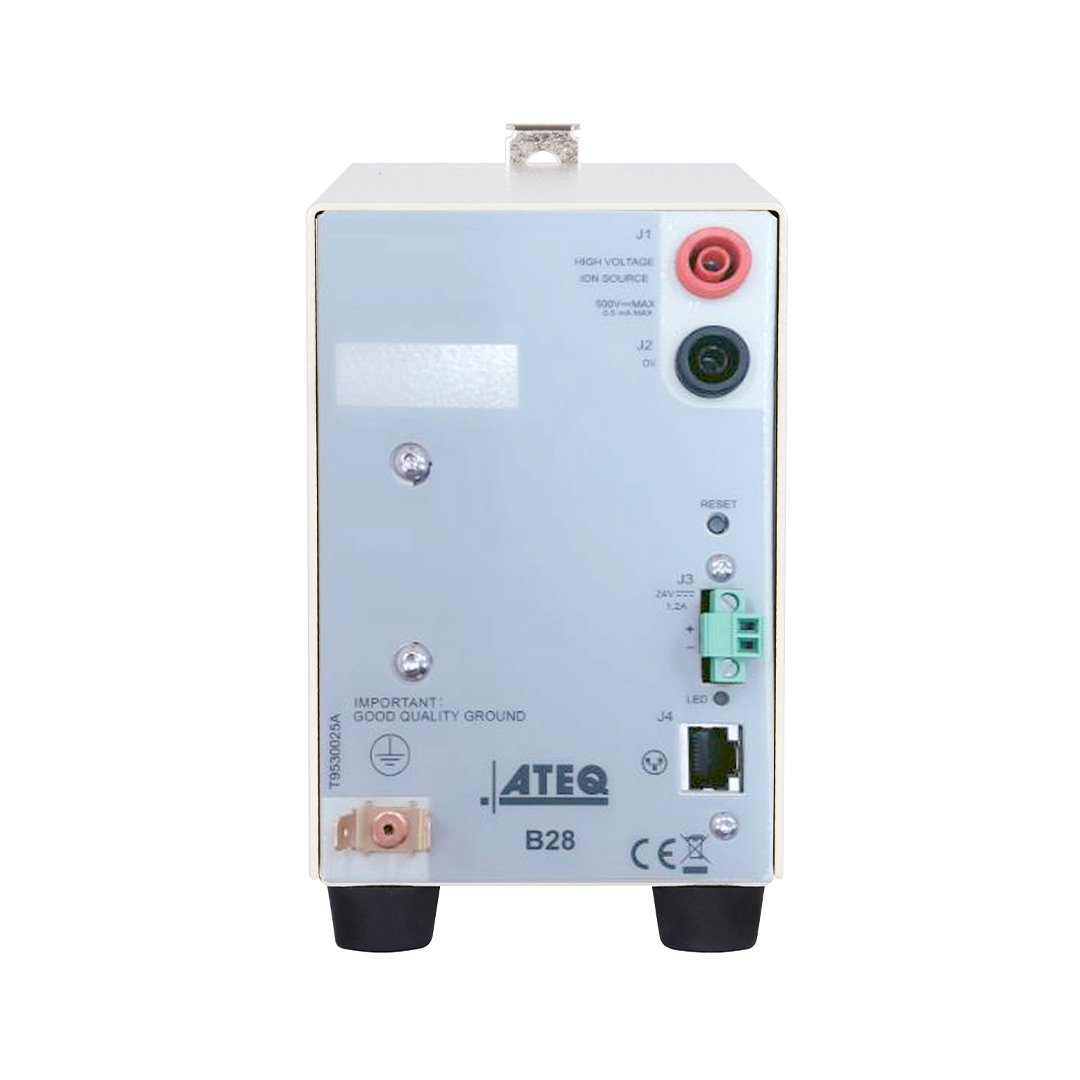
Ionized air leak testing:
This is a relatively recent technology, which is not widespread in the industry. The principle is to detect leaks using ambient air that is ionized and then moved with a voltage difference.
If there is a leak path, the ionized oxygen molecules in the air will flow through it. As the technology implies a voltage difference, it can only be applied to electrically insulating materials,.
like glass, non conductive plastics and rubber.
Since those materials are in general difficult to test with other air testing technologies like pressure decay or mass flow, the ionized air leak test can be a great alternative to tracer gas
like helium or hydrogen leak testing. Ionized air leak testing is less expensive than a helium or hydrogen test since it just uses electricity and ambient air.
The other advantage is that it tests at the speed of electricity: litteraly lightning fast.
So if you have a high volume production of parts made of electricaly insulating materials, this might be a good technology to use.
The ionized air test can also detect leaks in a given spot and can be used to locate leaks.
The ionized air tester can also be set up to detect a smaller leak than the ones found by an air pressure or vacuum test.

DIFFERENCES BETWEEEN AN IONIZED AIR LEAK TESTER AND A "SPARK TESTER"
The ionized air leak test should not be confused with "spark testers". An ionized oxygen molecule is not the same thing as a plasma.
Spark testers also use high voltage to detect a defect, with very high current that generates visible sparks seen by an operator.
The "spark testers" are very dangerous to the operator since they use high voltage and enough current to kill a healthy adult human.
When such a lethal power is present, the large amount of ozone they generate in the sparks seems to be only a remote danger but it is also a significant health hazard.
Another variation of the spark tester using a modified HiPot electrical appliance tester instead of a visual control to detect a defect is also potentialy lethal.
In comparison, the ionized air leak testers generate no visible sparks, and less ozone than an office copier machine. Like every plugged electrical equipment, you cannot let children play with it,
but a healthy adult human properly grounded can touch the ionized air generator during a test, feel the electric shock, without injury.
Of course ATEQ does not recommend to submit yourself to repeated small electric shocks, it is just a safety feature.

TYPICAL APPLICATIONS
Leak test of thin rubber gloves, condoms, rubber diaphragms, membranes, plastic films, Leak test of small plastic vials. Leak test of injection points in plastic bottles.
Medical devices or pharmaceutical packaging, high quality food packaging, household cleaner containers...

APPLICATION ISSUES:
Since ionized oxygen molecules do not travel as easily as a spark (plasma), there are some applications restrictions, some considerations in the test fixture design.
For all those know how questions, ATEQ has application engineers that know most of the common application problems and that can help you devellop an application
Although there is a measurement of the ionized air flow, the measurements do not correlate easily to a classic air test specifications.
The application can be set up to detect smaller leaks than an air pressure or vacuum based classic mass flow or pressure decay tester
The ATEQ applications engineer is there to listen to your needs, and recommend the best matching solution accordingly. Not a one shoe size fits everyone approach.

ATEQ's solution: Link to ATEQ Ioniq instrument leaflet